The Literature of Art
Within the realms of literature and literary study, there are hundreds of topics, genres, mediums, and subcategories which any interested individual can explore. In addition to these, there are many more which have not been recognized as legitimate literature by many professionals and literary minds. One such medium is the story telling form of complex narrative webcomics. This medium offers many new elements combined with old elements to the literary field that are going to waist if not recognized as having literary potential. People who ignore webcomics, claiming that they are not a true literary form because of their combination of visual images and text close off a creative possibility in a field where creativity shapes a majority of important topics and works. In order to fully understand this argument, it is important to grow familiar with arguments for and against the medium.
One argument frequently made against including complex narrative webcomics within the literary spectrum has to do with the drawings which are unique to the medium. Writers Eileen John and Dominic McIver Lopes say comics and webcomics that are "a work of fiction [and have] aesthetic merit may only be a work of art but not a work of literature" because the images cut out most of the reading and literary elements and take away from the need to read and analyze literary elements (Meskin). In other words, if a writer can’t describe actions and settings in words, then they aren’t writing literature. Others may argue that webcomics have the potential to demonstrate plot, back story, characterization, and elements of literature that can be found in dialogue, but so do television shows and movies. As Douglas Wolk points out in a recent book, comics and webcomics "bear a strong resemblance to literature-- They use words, they're printed in books, they have narrative content-- but they're no more a literary form" than movies or opera (Meskin).
Anne Magnussen takes this a step further in her book Comics & Culture: Analytical and Theoretical Approaches to Comics when she claims that webcomics are less literary than traditional medium comics due to their limitless potential to include animations, music, and interactivity in each panel. According to Magnussen’s claim, webcomics have come to depend more on their visual elements to demonstrate a story than the written elements. Despite continuing to include basic elements of literature such as puns and simile, she claims, they place more importance in looking at pictures than in reading. At one point, Magnussen claims that some people say "comics have taken the most unattractive and basic parts of both [art and literature] and combined them" into one medium (Magnussen 39).

As a writing major interested in the literary potential of webcomics, I believe these concerns are worth looking into. Do the visual elements of webcomics make them less eligible to count as literature? One might be inclined to say yes. However, I propose taking a deeper look at the visual elements of this medium and how they complement and lend to the literary elements. If webcomics are simply dismissed as having no literary value, the literary field could miss out on an entire medium offering creative new ways to express ideas and use existing elements of literature. To begin understanding this medium, one must take a look at the many steps a webcomic artist considers while creating their complex narrative work. In this process, an important step is determining what scenes to depict in which panels in order to drive the action, or plot, of the story forward.
Determining what action to include in which panel is a process called encapsulating. In a similar way to writing a novel, a webcomic artist “does not present each moment of action in the narrative,” but rather picks and chooses important parts to progress the story along (Duncan 131). Encapsulation can include decisions regarding the entire story-writing process rather than just a single panel. While making encapsulation decisions, a webcomic artist must determine the best method of conveying the story in a method that would be best for their work. They decide where it should slow down, speed up, focus on setting, flash back to the past, or imply that an action happened that was not represented physically in any previous panel. One item of special consideration during encapsulation is determining what happenings to represent in text and what to visually depict.
Within the dialogue or narration boxes of webcomics, literary elements such as symbols, metaphors, an d similes may be represented in text. However, not all of the symbols and metaphors available in webcomics are written as text. For example, symbols are a large element of the visual portion of webcomics, and can be shown in a variety of forms. One such form is commonly known as a sequence metaphor, which is a metaphor that takes two images and juxtaposes them in a way that combines their visuals to create a new meaning between the two. For example, placing the image of a superhero behind the image of a firefighter shows that the firefighter is the symbol of a real-life hero. Another manner of using symbols within webcomics is visual stereotyping. When using this technique, a webcomic artist depicts a character or scene in a manner that makes it resemble something else that it shares characteristics with. If a character is drawn with large glasses and a curved, pointy nose, he is likely an owl-like character who stays up late and keeps to himself.
Books and short stories use similar symbolic strategies in their pages, though theirs are not drawn on the page. One might mention that a firefighter character reminds a little boy of superman, or that a character who stays up late reading books wears large round-rimmed glasses and has a sharply curved nose. Both mediums use similar symbolism techniques (including some not listed here) either in text or visual representation. Symbols are an important element in literature, but are the visual symbols of webcomics less literary than the symbols represented in the text of books and short stories? Some would argue that it does because readers can simply look at the image and move on without analyzing it or without reading the text presented in the panel and still understand later happenings.
Rocco Versaci disagrees. In an essay titled “How Comic Books Can Change the Way Our Students See Literature: One Teacher’s Perspective,” Versaci advocates that comics (and thus webcomics) cannot be read without the visual context or looked at without reading the dialogue (Versaci). An individual must read the text presented alongside looking at the visual element in order to understand fully the happenings of the story. One cannot simply look at the action happening in the visual, or symbols such as the above mentioned and understand the deeper meanings of them without reading the dialogue balloons or narration boxes throughout. Likewise, one cannot simply read the dialogue between two characters discussing the actions of a third character and understand the full context without looking at the visual element. In this way, the textual and visual elements work hand-in-hand to deliver a new take on the storytelling process. Whether the author chooses to visually or textually represent the firefighter being juxtaposed with superman, the reader still must put the same amount of thought into deciphering the image before they can move on.

Take
a look at author Clay Gardner and artist Niko Geyer’s Fantasy realms, a
popular manga-style webcomic. The story begins en medias res, showing the
five hero characters in mid-conflict with an antagonist without explanation.
Through action and dialogue boxes, the author and artist use the popular
literary technique of telling a lot with very little in order to give readers a
feeling that the characters all have histories behind them that have brought
each of them to this point. The first two or three pages contain more action
and setting than actual dialogue, but the happenings within the panels are
important for moving the plot along. By the fifth page (the fourth page,
excluding the title page), important dialogue enters in when the antagonist
mentions that killing him will not bring back the past, giving the reader a
sense of foreshadowing.
As the webcomic moves into later chapters, similar combinations of important action panels and important dialogue panels come into play to give the reader an experience which requires reading and viewing in order to get the whole picture. A person could probably look at the visuals of the first chapter and get an idea of the plot being en medias res as well as understanding who the antagonist is as opposed to the protagonists. They could even understand that the scene is a climactic fight between the heroes and the villain, but without reading the dialogue between the characters it would be difficult to understand the sudden transition into chapter two, which jumps back into the past just before the protagonists met one another. Without important dialogue clues mixed with visual, a reader might be able to understand the basics of a complex narrative webcomic, but could not understand everything.
Another argument frequently made against webcomics being literature due to their visual elements is that they don’t describe characters, background, feelings, or the mood of the setting. This argument is prevalent despite the fact that these elements are not always present in works currently regarded as literature. For example, in plays written by William Shakespeare emotions, setting, and mood are not described except for in occasional brief acting notes directing future generations on how a pivotal scene is to play out. Instead, these elements are deciphered by readers through the dialogue between characters which is written in a manner that leads readers to understand the unmentioned. Unlike these great plays, webcomics include the elements in question through  visual effects in addition to dialogue and tone of the characters or narrator like Shakespeare used in those plays. There are many ways to depict mood, setting, inner emotions, and characters beyond words.
Webcomic artists use visual representation rather than textual description to present a setting to their audience. However, just like in a written book, they must be choosy about their mode of presentation to achieve the desired effect. For example, if a webcomic takes place in a forest, the artist must take great care in the way they present that forest so it can achieve the greatest amount of effect on their story as a whole. If the forest is dark and frightening, various darker shading and heavy line techniques may be used. If the forest is a neutral location for the character, then smooth lines are used and only enough shading to convey a sense of being three-dimensional. Another consideration is how much emphasis an artist wishes to give the forest.
In books and stories, if a writer does not wish for the setting to
 draw too much of the reader’s attention, they will only dedicate enough lines to its description to
let the reader know where the story is set. If they wish for hea
vy focus to fall on the
setting, a writer will sometimes dedicate entire paragraphs to elaborately describing it, or mentioning it frequently. Webcomic artists use similar techniques, but without words. If the setting is less important than the action, sometimes lines are blurred together after one or two panels depicting things clearly, or objects are merely represented by fuzzy shadows or patches of color. In times when the setting is more important, it can be inked as heavily as the characters or drawn more in the middle of large panels. Sometimes, more emphasis is placed on especially important settings by stating facts about them or observations in dialogue.
draw too much of the reader’s attention, they will only dedicate enough lines to its description to
let the reader know where the story is set. If they wish for hea
vy focus to fall on the
setting, a writer will sometimes dedicate entire paragraphs to elaborately describing it, or mentioning it frequently. Webcomic artists use similar techniques, but without words. If the setting is less important than the action, sometimes lines are blurred together after one or two panels depicting things clearly, or objects are merely represented by fuzzy shadows or patches of color. In times when the setting is more important, it can be inked as heavily as the characters or drawn more in the middle of large panels. Sometimes, more emphasis is placed on especially important settings by stating facts about them or observations in dialogue.Webcomics also use various shading and line techniques to depict mood that would be shown through descriptive or connotation-loaded words in a book or story. For example, in a scene where a character feels unsettled by their surroundings, an artist might draw wavering lines on or around them, and place stress lines on their face and in their eyes to emphasis the effect the background is having on the character. These techniques are no less analyzable with the general story as a whole than written descriptors of a character feeling goose bumps run up their arms upon entering a cemetery. In some ways, the visual representation of such elements is a formatting choice as well as a strategic manipulation of space. Rather than captivating the reader's full attention with descriptors, webcomic artists have the ability to combine the action with the descriptor by visually depicting feelings and backgrounds and leaving the reader's attention almost entirely on the written dialogue in times that it is important. The visual element may help artists present a setting and a character's physical reaction to a happening during the action that books or stories may be forced to leave out so as not to distract the reader with too much detail. Neither way is better than the other because both are stylistic choices made by the writer.
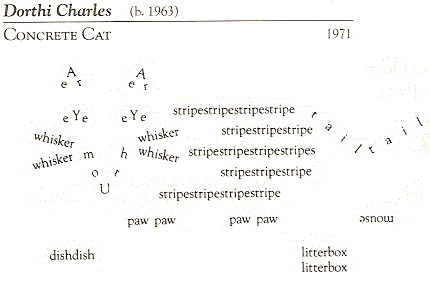
One might argue that because webcomics rely on these visual images to support the story and move it along, they are not literature. However, there are many instances in which items considered as literature by most individuals rely on images, patterns, or colors to depict an important element of the work. The calligram titled The Concrete Cat by Dorthi Charles is an example of a poem in which a central element is the image. As with any calligram, Charles uses words that don't necessarily create a traditional poem filled with alliteration, rhyme, listing, or even meter, but rather to create the image of a cat on the page. In his book Comics as Culture, M. Thomas Inge points out that Mark Twain also placed value in the combined power of visual and textual story telling. He relates that Twain wanted Huckleberry Fin to be told in the first person narrative, but couldn't describe what the sly protagonist looked like or most of the settings familiar to Huck because it wasn't in his personality or narration style. To supplement his works, Twain (with the help of artist friends) originally drew pictures of his protagonist and a few select settings to give his audience an idea of their looks without interrupting the story. Inge notes that "Mark Twain continued to believe in the power of pictorial narrative in his later books, and on one occasion even allowed the pictures to move beyond the text itself," including several images in his lesser known A Connecticut Yankee in King Arthur's Court that were only vaguely mentioned in the text itself to give the audience a deeper feeling of connectedness and to extend the deeper meanings of the text (Igne 134).
Accepting that the visual elements combine with the textual elements in comics puts them up for eligibility in the literary field may not leave some literary individuals believing that webcomics are also part of the literary field. As mentioned by Magnussen in her book Comics & Culture: Analytical and Theoretical Approaches to Comics, many popular webcomics have come to include animation, music, sound, and other elements made available by the limitless potential of the internet medium. I would argue that the limitless media potential of webcomics is something that any form of literature has the potential for when placed on the internet and helps feed the creative potential of the medium with new ways of emphasizing meanings and drawing in audiences. One traditional literary form that has become widely recognized as retaining literary value even after gaining interactivity, noise, and animation on the internet is poetry.
In recent years, a trend of visual and interactive poems under many titles has hit the literary field. These poems are most often called abstract poetry or visual poetry due to the many unique forms available. Some of these poems feature words flashing rapidly on a screen in varying sizes, colors, fonts, and patterns to bring about a mood or situation in a new way. Others use floating text that moves and changes when interacted with by a cursor, while others require readers to click on words and pictures to bring them to different areas of text. The poetry by Diane Greco featured on the Riding the Meridian website is an example of this abstract poetry that uses flashing animations, click-able images, and words in combination to create a new medium either for entertainment, or serious analysis. This form of poetry has been fighting for its place in the literary spectrum ever since it first got going. In today's literature classes, these types of poems have achieved limited recognition (mostly in creative writing poetry classes) and are taught as a medium within the wider spectrum of poetry.
Webcomics hold as much literary potential as the abstract and visual poems now being recognized by various creative writing classes around the United States. Webcomic artists have combined the visual symbols and line techniques for mood changes with text to produce a unique hybrid form that relies heavily on both the art and literature elements to produce a story. One can no more look at only the drawings and appreciate the depth of the medium than they can look at only the text. For a full understanding of the meanings and complexities within a webcomic, one must analyze both elements side by side along with animations or sounds afforded by the internet medium. I am not suggesting that webcomics are any more part of the great cannon taught in literature classes than Harry Potter or Seussical the Musical, but that they should be considered as part of the literary field. Similar to visual and abstract poetry, this medium may be able to gain some ground in recognition if creative writing classes start considering them as a medium worth dedicating even one class period to studying or if writers of literary-focused essays and books gave them even a brief mention in their works.
Carla Vangrove studies English with an emphasis in creative writing at Colorado State University in Fort Collins. Her central focus in these studies is not how creative mediums fit within the literary field, though she enjoys researching this on the side for her writing arguments class. As a creative writing student, she believes in not entirely limiting the literary potential of mediums without thoroughly researching the medium and considering all arguments for and against it.
